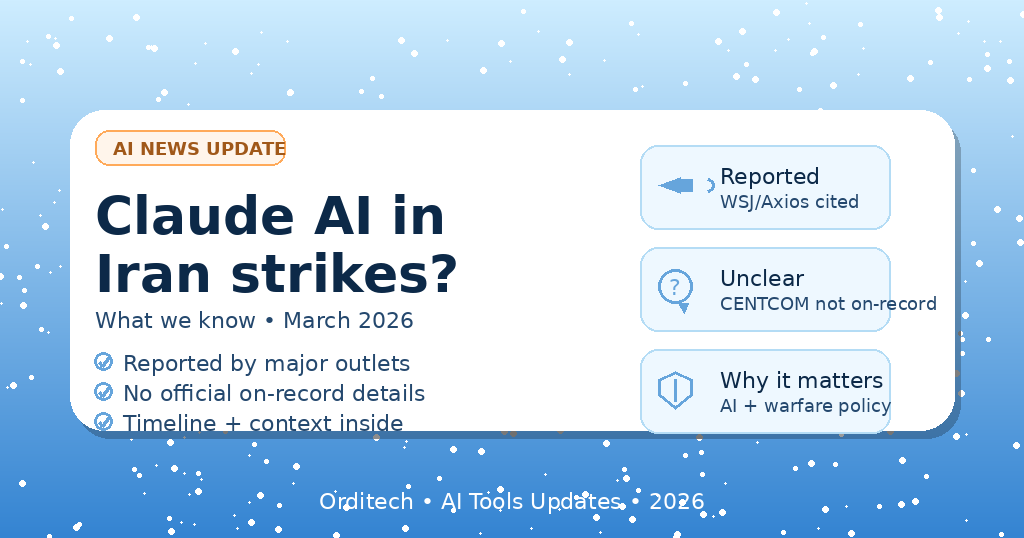

Update (March 2026): Several outlets reported that the U.S. military used Anthropic’s Claude during strikes on Iran. However, there is no public, on-record confirmation detailing exactly how it was used. This post breaks down what’s reported, what’s unclear, and the timeline around the federal phase-out.
Related reads:
Best Free AI Tools (No Sign-Up) •
ChatGPT Not Working? 13 Fixes
Table of Contents
- Quick answer (is it true?)
- Timeline: what happened when
- What the reports claim
- What’s still unclear
- Why this story confused people
- Why it matters (AI + warfare)
- How to verify fast (avoid misinformation)
- FAQ
- Sources
Quick answer: is it true?
It’s “reported,” not fully “confirmed.” Jang and other outlets say Claude was used during the Iran strikes, but the public record does not include a detailed on-the-record confirmation explaining exactly what the model did, who used it, and under what operational constraints.
Best way to say it: “Multiple reports claim Claude was used; exact usage details are not publicly confirmed.”
Timeline: what happened when
- Feb 27, 2026: Reuters reported President Trump directed federal agencies to stop using Anthropic technology, with a transition/phase-out period mentioned for agencies that already used it.
- Mar 2, 2026: Reuters reported agencies such as Treasury and State were terminating use of Anthropic products; State was switching an internal chatbot to OpenAI’s GPT-4.1.
- Mar 2, 2026: Jang reported Claude was used during strikes on Iran for tasks like intelligence analysis, identifying targets, and running “what-if” battle scenario exercises.
What the reports claim
According to the reporting summarized by Jang, Claude was used during the operation for:
- Intelligence analysis (processing and summarizing information)
- Identifying potential targets
- Running “what-if” scenario simulations to test options
Some coverage also notes the timing tension: the phase-out/ban direction was reportedly issued close to the operation, which can create overlap between policy change and active systems still in place.
What’s still unclear
Even if AI was used, key details often remain unknown publicly:
- Scope: Was Claude used for high-level summaries only, or deeper decision support?
- Human control: What were the review steps, and who approved outputs?
- Data access: What data was fed into the model and under what restrictions?
- Operational role: Advisory/support vs. direct targeting decisions (very different implications)
Until there’s an official statement with specifics, treat “how exactly” as unresolved.
Why this story confused people
Most confusion comes from mixing two different ideas:
- Policy change: A directive to stop/phase out a tool at the federal level.
- Reality of operations: Large systems often have transition windows where the tool still exists in workflows while replacements are being arranged.
So you can see headlines that sound contradictory, even if the real situation is “phase-out started, but legacy access still existed.”
Why it matters (AI + warfare)
This story matters because it highlights a bigger trend: AI is moving from office productivity into national security workflows. That raises questions about:
- Accountability (who is responsible for AI-assisted decisions?)
- Transparency (what should the public know?)
- Safety and ethics (limits on military AI use)
- Procurement and supply-chain disputes (who provides models to government?)
How to verify fast (avoid misinformation)
- Check primary reporting: Reuters summaries and direct statements carry more weight than viral screenshots.
- Look for on-record confirmation: If it’s “sources said,” treat it as reported—not proven.
- Separate “used AI” from “AI chose targets”: Those are not the same claim.
- Watch timeline wording: “Immediate stop” vs “phase-out period” can change interpretation.
Related: How to Write Better ChatGPT Prompts (for understanding AI limitations + reliability).
FAQ
Was Claude definitely used in the strikes?
It has been reported by multiple outlets (including Jang’s summary), but official on-record details about the exact usage are not publicly clear.
Does “AI used” mean AI picked targets?
Not necessarily. AI can be used for summarizing intel, generating checklists, translation, or scenario exploration. Target selection is a much stronger claim.
Why would agencies stop using Anthropic products?
Reuters reporting describes a federal directive and agencies beginning to terminate use and transition tools. Specific motivations and disputes are part of the broader policy story.
Will governments use AI more in defense?
Almost certainly yes—especially for intelligence workflows. The debate is about boundaries, oversight, and accountability.